 My favorite waseieigo (和製英語) or Japanified English, is the word プリクラ。Purikura is short for “purinto kurabu,” which is the way the Japanese pronounce “Print Club.” It is a made-up term that the Japanese created for a machine that already has a name in English: the photo booth. But like its new name, the Japanese have taken the simple photo booth and transformed it into a whacky, whimsical, stylish, silly, zany, creative, narcissistic form of entertainment that I am kind of obsessed with.
Since coming to Japan, I have visited quite a few purikura booths. You can find these booths primarily at arcades, but I have also found one in a giant 100 Yen shop by Machida Station that closed down recently (Daiso Giga, may it now rest in peace). In Harajuku, the fashion district of Tokyo, some venues are dedicated to nothing but these photo booths.
The whole purikura process is fairly simple. You and your friends find a booth. (The booth comfortably fits between two to four people, but I once found a stray purikura photo on the ground and counted 18 heads crammed into the frame).  It costs 400 Yen for a series of 4-6 shots. Once the photos are taken, you and your friends can digitally doodle on the photos before the booth prints out several copies of thumbnail-sized, freshly doodled photos on fun sticker paper. Your tiny, customized photos are now stickers that can be used to decorate notebooks, folders, laptops, refrigerators, dog collars, bumpers, and more.
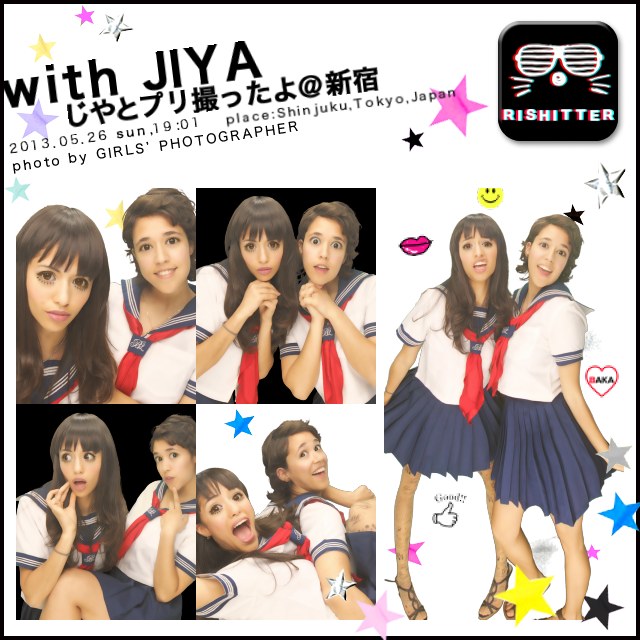
But purikura is so much more than a sticker. This quirky, paradoxical cultural product provides a space for people to express their individuality and play out their fantasies while simultaneously revealing much about Japan’s social norms, expectations, and restrictions. Take my recent trip to a purikura booth at an arcade in Shinjuku with my sister, as an example. There are many purikura booths around Machida station, but the two of us traveled the hour or so to Shinjuku in order to partake in a special purikura experience: cosplay.
Cosplay [noun, verb]: another waseiego word; a combination of the words “costume” and “play”; to cosplay is to dress up as your favorite anime character (or simply to wear a costume in general) and make any typical day feel like Halloween.
 First, my sister and I go up to the fourth floor of the arcade, which is filled with dozens of booths. We approach the front desk and find a binder filled with pictures of costumes that we can borrow, free of charge, and don while taking our purikura photos. There are many costumes to choose from: Pokémon and Sailor Moon characters, Alice from Alice in Wonderland, a geisha assassin, a nurse, a school girl, a maid…it goes on and on. There is also a decent collection of random wigs at our disposal. We can change costumes as many times as we like. We decide we want to be the infamous/coveted/adulated/sexualized/immortalized/innocent Japanese schoolgirls.
We wait in line for the changing room, and then we wait in line for a free booth. (This place is quite popular!) Like the costumes, there are many kinds of specialty booths to choose from. Some are classy, some zany and wacky, some cute and girly, but all are stylish.  We choose the one with the shortest line. Once inside, we insert four 100 Yen coins (about $4 USD) into the slot and select our picture settings. How big do we want our eyes to appear? (They range from natural to anime huge.) How white do we want our skin to appear? (Choose from our natural tone to very pale.) We go for big eyes and our natural skin shades. It is interesting to note that one cannot choose to have smaller eyes or darker skin, because those features are not considered desirable in a woman. The bigger the eyes and lighter the skin, the more attractive women are supposed to feel. This conception of beauty not only limits the options in the purikura booth, but also encourages many Japanese females to wear size-enhancing contact lenses, eye-popping makeup, and large, fake eyelashes. Skin whitening cream is also popular. Janet and I decide we will go for the big eyes, but we like our skin color, so we keep it natural.
Then, our close-up begins. The machine only allows us about ten seconds to decide on a pose before it snaps a shot. There is a screen that allows us to see how we look so we can adjust ourselves accordingly. The screen also briefly displays girls modeling in different positions for us to imitate if we can’t think of any poses ourselves. Four to seven shots later, we are prompted to exit the photo area and begin doodling on the touch screens on the side of the booth.
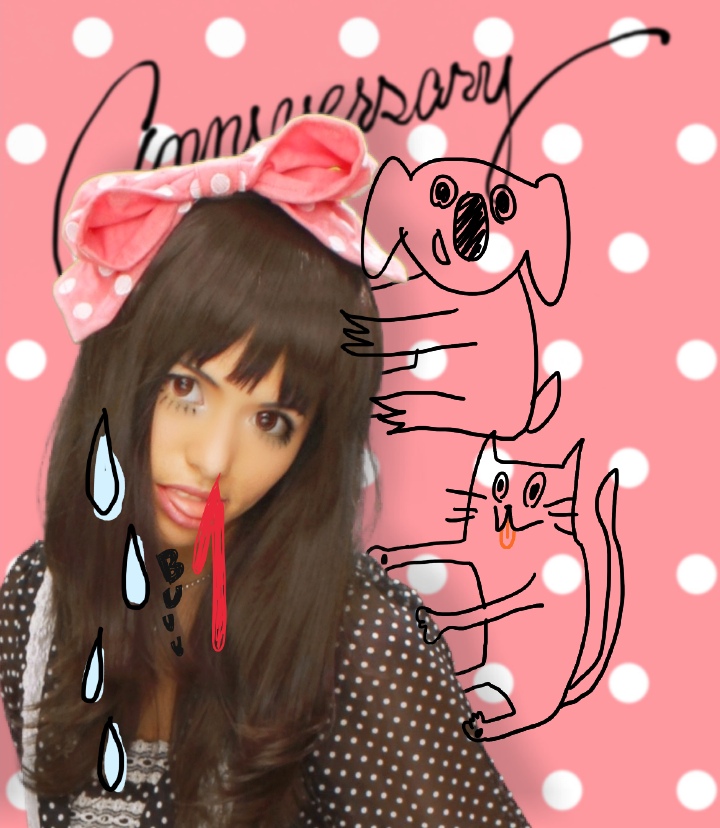
Doodling on the photos is my favorite part of the purikura experience. You can write anything you want or select pre-made doodles and phrases. You can choose to put a panda on your friend’s head or give them bunny ears and a beard. You can change the backdrop to look like you are being eaten by a bear. You can change your eye color; hair color; add blush and lipstick. You can make bubbles and sparkles come out of your head, or out of your friend’s butt. Self-expression, creativity, and absurdity run rampant at the doodling booth, and once you are satisfied with your creations, press “print” and wait for your picture/stickers to arrive. Here’s one of my favorite doodles:
But not just anyone is allowed to enjoy the print club. Boys are not allowed in purikura booths unless they are accompanied by at least one girl. Why can’t two guys take purikura together? Why can’t one guy take purikura just for fun? I have a few guesses. First, purikura is known as a female pastime. It is almost exclusively tailored to women. The makeup, the big eyes, and the white skin options, the chou-kawaii or hyper-cute backdrops, all of these things are aspects of the feminine beauty aesthetic. Purikura booths are very gendered spaces, and store policies limiting the male presence in these spaces reinforce that. (In any case, the accepted opinion is that males aren’t supposed to enjoy purikura—they are just supposed to be dragged along by their girlfriends or wives.)
Another reason why this “accompanied males only” policy exists is probably in order to protect girls and women from chikan (loosely translated as “pervert”). It is commonly known that Japan has a chikan problem, and preventative measures are taken in situations where many people congregate (special women-only train cars, reserved “women safety” seating on buses, etc.). Print club areas get quite crowded, and because it caters primarily to females and lets them dress up in maid and schoolgirl costumes, it can quickly become a popular place for creepy guys to loiter around in. Regardless of the reasons why the policy exists, the key point here is that the gender segregation in purikura culture is similar to the gender segregation that permeates through many aspects of Japanese society. (One example is how my students self-segregate themselves by gender in my classroom, with the boys on one side and girls in the other. This is a remnant of grade school, when such seating is compulsory.)
With all this having been said, I am still a victim of vanity and like to take pictures of myself with my friends. I love stickers. I love to doodle. And that is why I ❤ プリくラ.
 Lissette Lorenz
Leave a comment