Note: This post includes lesson plans and hilarious examples. If you are mainly interested in the art, read the first two paragraphs below and then skip down to the drawings. If you are interested in the activity, I have included a detailed list of steps for execution in the classroom.
I like to make my English classes as creative as possible. One of my favorite creative classroom games is called “Telephone Pictionary.” As the name implies, it is a combination of the game Telephone and Pictionary. In the first game, people stand in a line or a circle and the first person whispers a sentence in the next person’s ear, and then the next person must transmit that same sentence to the next person, and on and on until everyone has received the message. The fun part is that because the message is whispered, somewhere along the line someone will incorrectly hear the message and transmit an erroneous one. Mistakes might continue to be made until the original message has gone from “I like bananas for lunch” to something like “Mike’s pajamas formed a punch” or “I like bandanas made from mulch.” In Pictionary, someone draws a picture as quickly as they can and someone else has to guess what it is before time runs out. Combine the two games, and you get a very fun and creative way to practice English.
I first learned to play Telephone Pictionary in high school. My classmates and I played this game secretly, when class time was boring and we were looking for surreptitious entertainment. Here’s how the game worked. The student sitting at one end of the class would take out a sheet of notebook paper and draw a whacky picture with lots of interesting things going on at the top of the sheet. Then they would pass it to the person next to them. Person number two would look at the drawing and would then write a sentence underneath describing the picture. Then, person number two would fold back the picture, leaving only their sentence visible, and pass it to the next person. Person number three would look at the sentence and draw a corresponding picture, fold back the sentence they received, and pass it on.
My classmates would discreetly pass around this note consisting of a series of pictures and corresponding sentences describing those pictures. The note was folded in such a way that when the note reached you, you could only see the most recent addition to said note by the person who passed it to you–either a picture or a sentence. If you got the former, you would write one sentence describing what you see. If you got the latter, you would draw a picture of what the sentence described. The best part of the game was unfolding the paper once it was filled up and watching the progression into chaos. The original drawing almost always transformed into something unexpected (and often hilarious) by the end of the game.
I decided to introduce Telephone Pictionary to my students, because it requires the ability to both comprehend and produce English (and it’s so fun!!!). I also give them only two minutes to produce either a sentence or a picture. I don’t let my students use their dictionaries when they play this game, which really makes them think on their feet and try to be as descriptive as possible given the vocabulary that they know.
If anyone is interested in playing this game in their English class, here are the steps and examples of the finished product. You can play this game with anywhere from 6 to 40 students. (You could play with even more, they just probably won’t be playing in circle formation, but instead would pass their sheets up and down rows.)
1.) Have the students move all their desks into a big circle. If no desks are around, have them sit on the floor in a circle and have something hard to write on.
2.) Pass out a long sheet of paper to each student. (I take Metric size A2 office paper [420 x 594 mm or 16.5 x 23.4 inches] and cut the paper in half lengthwise to form 8.25 x 23.4 inch sheets.)
3.) Students write their names on the bottom of the sheet, then flip the sheet over.
4.) At the top of the paper, each student will be given two minutes to draw a picture of whatever they want so long as it is dynamic, exciting, interesting, or crazy. Remind them that it doesn’t have to look good. It’s not about the art, it’s about the interpretation.
To help incorporate English grammar, tell students they must include the following items in their drawings: at least 3 nouns, one of which must be a place and at least one of which must be the subject, and at least one verb/action being performed on or by the subject.
I write the checklist of items needed in their drawings on the board, review the grammatical terms (subject, object, verb, noun), draw an example picture on the board, and then point out each required item from the checklist as it appears in my drawing. If the students’ English levels are low, I give them about 5 minutes to produce the first image.
5.) After students have completed their first drawing at the top of their papers, I go around the circle and check to make sure each student has incorporated all the items on the checklist. I might tell them to add a place or add a person/animal/object, for example. This step sounds time-intensive, but it really isn’t. Pictures that include all the items on the checklist are dynamic, and you can tell at a glance if something is missing because the picture will most likely be static, like a rabbit floating in empty space.
6.) Next, students pass their drawings to the person to their left (or right, if you prefer–I’m a lefty and am therefore adamant about pursuing lefty rights–lefts–lefty lefts–sorry that was a dumb joke).
7.) Students are now looking at someone else’s drawing. Below the drawing, they will have two minutes to write a sentence describing what they see. Their sentences should also include the grammatical items on the checklist according to what they see in the picture. You can go around and check people’s sentences to make sure they have all the elements. Again, if they are lower level, allow them more than two minutes to come up with their sentences. Don’t let it get too slow though, or the game will lose its pacing.
8.) Once they have written their sentences, students fold back the top part of the paper that has the drawing, leaving only their newly written sentence on top of the paper. Then they once again pass the paper once to their left (or right, if that’s your kind of thing for some reason).
9.) Now students should be looking at someone else’s sentence only (not the original picture), below which they will draw a corresponding picture. (Again, remind them to include all the items on the checklist.) Once they have finished their pictures, they fold back the sentence above it, leaving only their drawing at the top.
10.) Students pass their papers to the next person to the left (or the right, if you like to oppress lefties). The main thing is that the papers are always passed in the same direction for the entire game.
11.) Now the students will once again write a sentence describing the picture they have just received. Once they have finished, they fold back the picture, leaving their sentence at the top, and pass it one over.
12.) Repeat steps 9-11until students reach the end of the sheet and have no more room. Have them look at the backs of the papers for the original owner’s name and pass the papers back to their original owners for review of the finished product. You can have them pass the finished papers around for their classmates to inspect (and laugh at). This game lasts about 45-60 minutes for a class of 30 students.
Below are some examples of the finished products. These are some of the ones I found particularly amusing. (I have colored them for the full effect.) I am never disappointed when my students play this game, and they have a really good time too. The better they get at the rules, the faster they can play, and the crazier (better) things turn out.
Enjoy!!!
Example 1: Fly or Fry


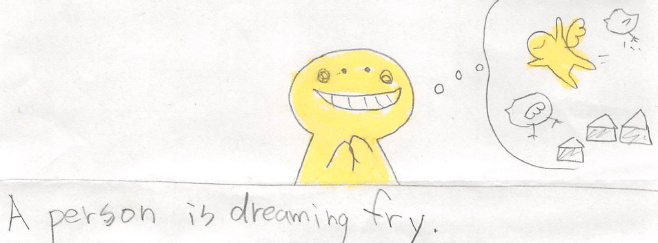
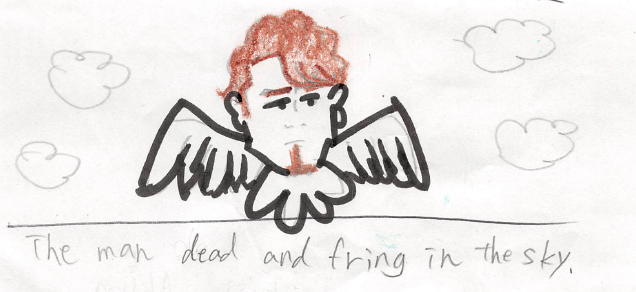
Example 2: Tribute to the Teacher

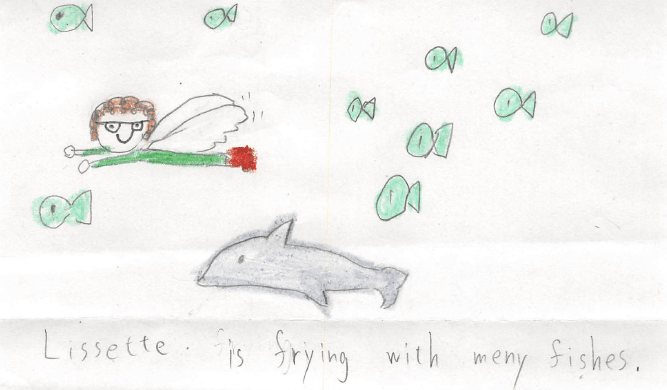
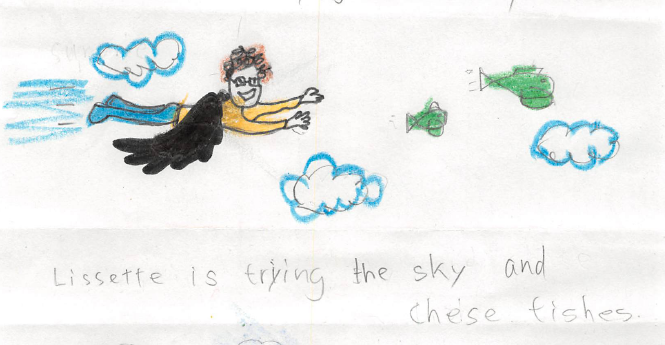

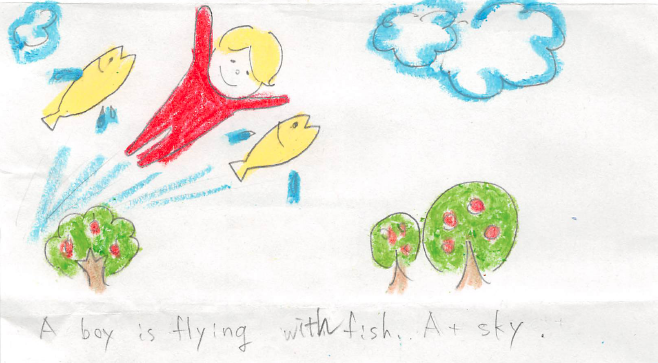

Example 3: Japan’s New World Heritage Site


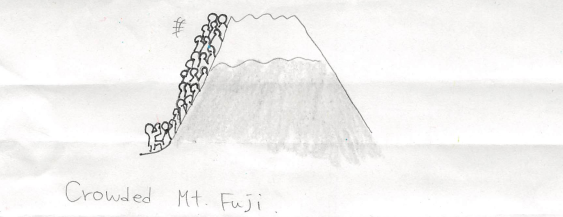
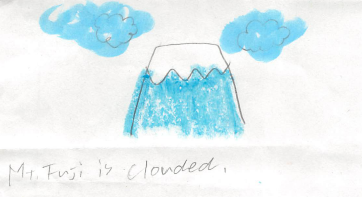
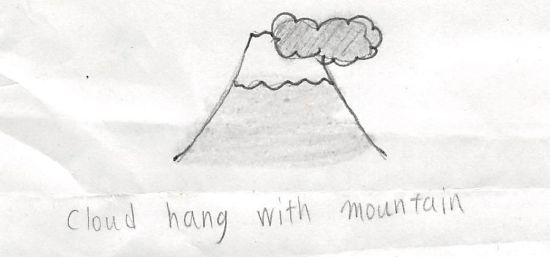
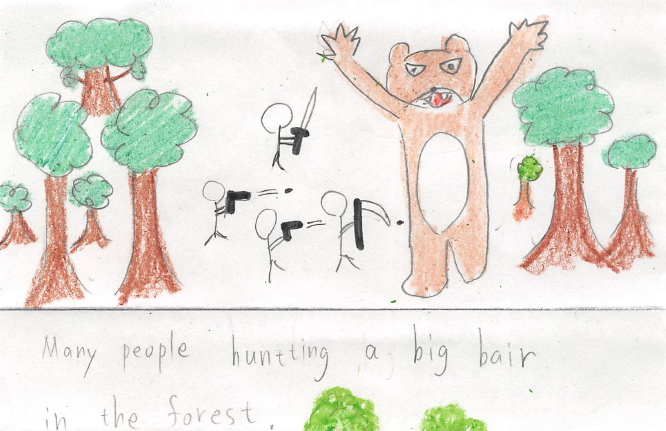
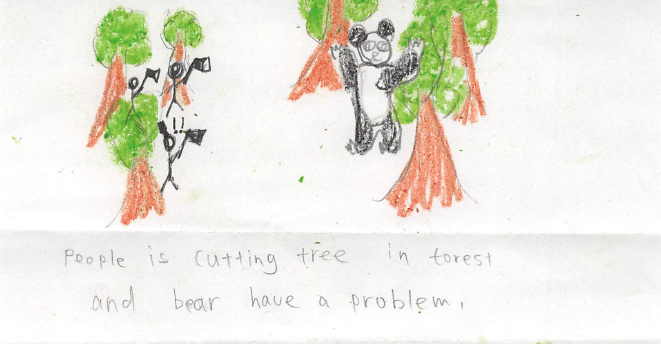
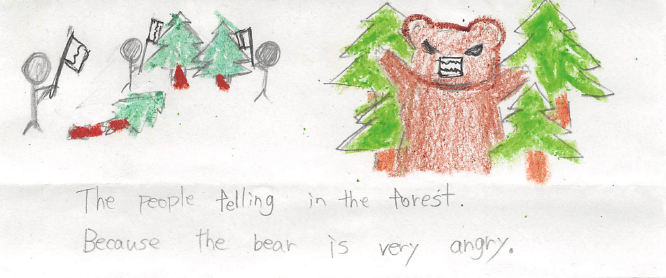
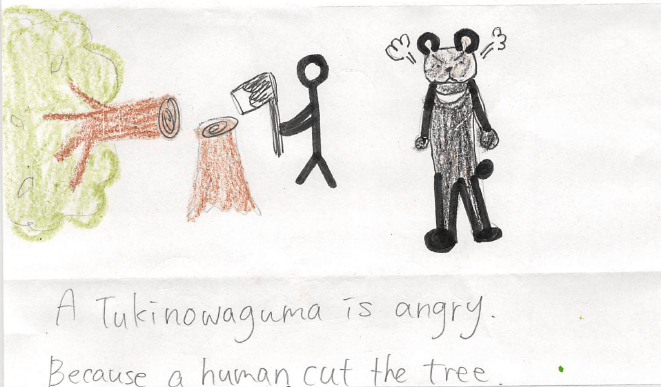
Example 4: Beware the Bear
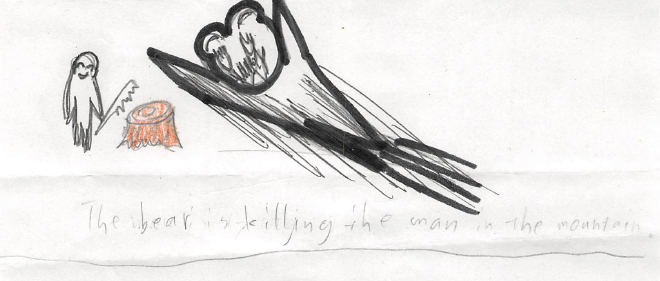

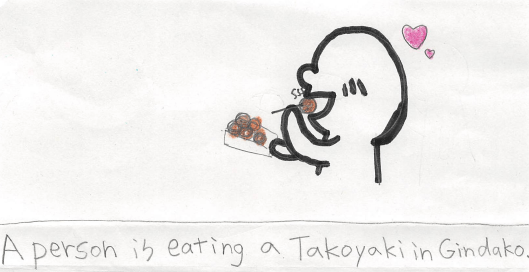
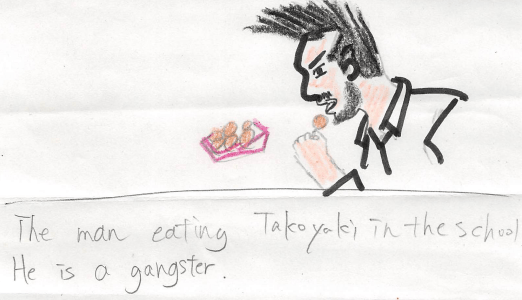
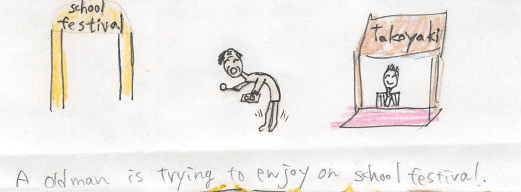
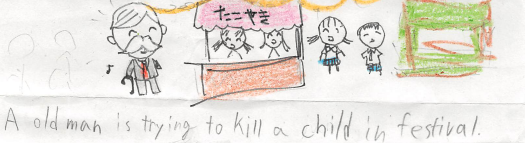
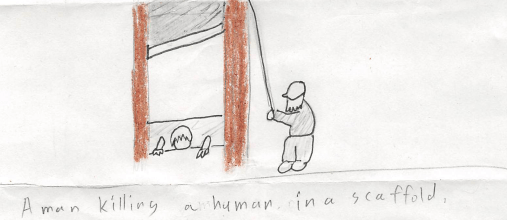
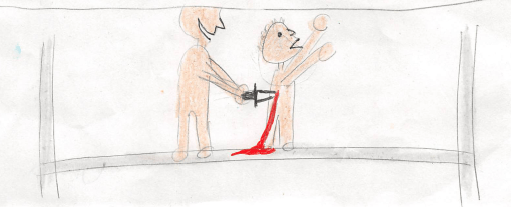
Example 5: Takoyaki Terror
Note: I went a little crazy on Youtube as I went looking for a good video that explains what takoyaki is, and ended up finding some rather interesting videos. I couldn’t decide which one to pick, so I decided to attach a video to each picture. If you hover over the picture, you will find a description of the video and why I like it so much.

 Lissette Lorenz
Leave a comment